

Canada’s Employment Insurance (EI) program provides temporary financial assistance to workers who have lost their jobs through no fault of their own, such as during a shortage of work or seasonal layoffs. Managed by the federal government, the program is funded by premiums paid by both employees and employers.
Table of Contents
Key Types of EI Benefits
While most people think of EI strictly as “unemployment” support, the program covers several major life events:
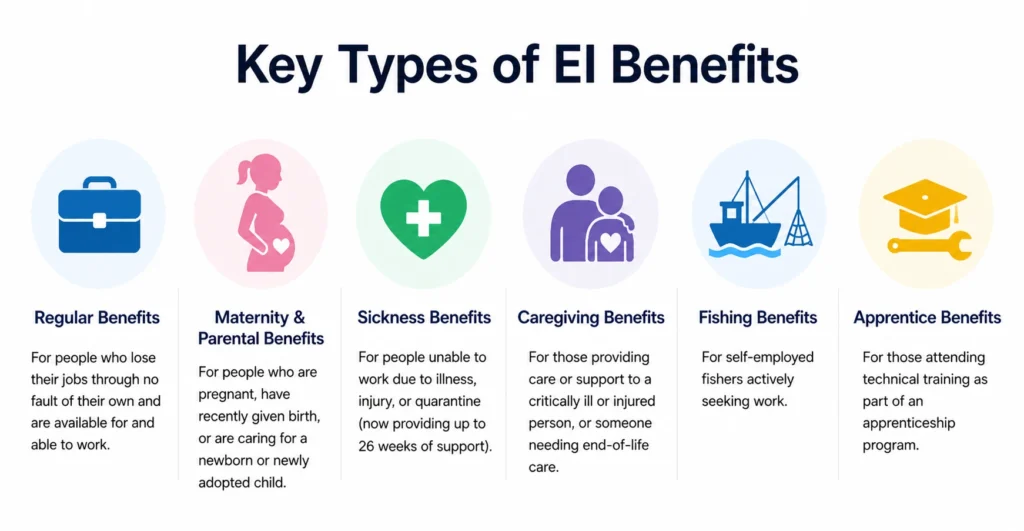
- Regular Benefits: For people who lose their jobs through no fault of their own and are available for and able to work.
- Maternity & Parental Benefits: For people who are pregnant, have recently given birth, or are caring for a newborn or newly adopted child.
- Sickness Benefits: For people unable to work due to illness, injury, or quarantine (now providing up to 26 weeks of support).
- Caregiving Benefits: For those providing care or support to a critically ill or injured person, or someone needing end-of-life care.
- Fishing Benefits: For self-employed fishers actively seeking work.
- Apprentice Benefits: For those attending technical training as part of an apprenticeship program.
Eligibility Basics
To qualify for regular EI benefits, you generally need to meet three main criteria:
Work Hours: You must have worked a minimum number of insurable hours in the last 52 weeks. This usually falls between 420 and 700 hours, depending on the unemployment rate in your region.
Job Loss Reason: You must have lost your job for reasons beyond your control. You are typically not eligible if you quit voluntarily without “just cause” or were fired for misconduct.
Availability: You must be actively looking for work and ready to accept a suitable job.
Payment and Duration
Amount: Most people receive 55% of their average insurable weekly earnings. For 2026, the maximum yearly insurable earnings are $68,900, meaning the maximum weekly benefit is $729.
Duration: You can receive benefits for anywhere from 14 to 45 weeks, depending on the regional unemployment rate and how many insurable hours you accumulated.
Example EI Benefits Payment Calculation (2026)
To estimate your EI benefits, Service Canada typically pays 55% of your average insurable weekly earnings, up to a maximum weekly limit of $729 in 2026.
Example: Suppose your average weekly earnings were $900.
- Apply the 55% rate: $900 × 0.55 = $495
- Compare with the 2026 limit: Since $495 is below the $729 maximum, you would receive the full $495 per week.
- Total Support Duration: If you qualify for 26 weeks, your total support would be $12,870 ($495 × 26).
If you earned $1,325.45 or more per week, you would hit the cap and receive the flat maximum of $729 per week.
Example: Let’s say your annual salary was $80,000, which averages out to approximately $1,538 per week.
Step 1: Apply the 55% EI rate
- 55% × $1,538 = $845.90
Step 2: Compare with the 2026 maximum weekly limit
- For 2026, the maximum weekly benefit is $729.
- Since $845.90 is higher than the limit, your payment is capped at the maximum.
Estimated EI payment: $729 per week
How to Apply for EI Benefits
You should apply immediately after you stop working. If you wait more than four weeks after your last day of work, you risk losing your benefits entirely.
1. Submit the Online Application
Visit the Service Canada EI Application page. The process typically takes about 60 minutes.
2. Gather Required Documents
- Social Insurance Number (SIN)
- Record of Employment (ROE): Employers usually submit this electronically. You can view yours via your My Service Canada Account (MSCA).
- Banking Information: Required to set up direct deposit.
- Employment History: Details for all jobs held in the past 52 weeks.
3. Receive Your Access Code
You will receive a benefit statement in the mail containing a 4-digit access code, which is required to submit your mandatory bi-weekly reports.
Working While on EI Claim
You can work part-time while receiving EI and will almost always end up with more total income than on EI alone.
The “50 Cents” Rule
For every dollar you earn in wages, Service Canada deducts 50 cents from your weekly EI benefit. You keep 100% of your wages, and 50% of that amount reduces your benefit.
The “90% Cap”
If your earnings plus your EI benefit exceed 90% of your previous weekly earnings, any earnings above that cap are deducted dollar-for-dollar.
The 35-Hour Full-Time Cutoff
If you work 35 hours or more in a single week, you are considered “fully employed” for that week and will generally receive $0 in EI benefits, regardless of your earnings.
Learn More: Working While on EI: 5 Smart Rules to Protect Your Benefits
Severance and Vacation Pay (Temporary 2026 Rules)
Under temporary measures in effect until October 10, 2026, the rules regarding separation money have been suspended to favor the worker.
- No Delays: Severance packages, pay in lieu of notice, and cashed-out vacation pay do not delay the start of your EI benefits. You can receive your full payout and start EI immediately.
- Time Off vs. Cash: If you take actual “time off” (vacation) while on a claim, you are not considered “available for work” and must report those days, which will stop your payment for that period.
Six Hidden Rules to Protect Your Claim
1. The Waiting Period (Waived for 2026): While EI normally has a one-week waiting period, this has been temporarily waived for claims starting before October 10, 2026. Eligible claimants receive benefits starting from the first week.
2. Mandatory Bi-Weekly Reporting: You must submit a report every two weeks online or by phone. Failure to do so will stop your payments.
3. ROE Bottlenecks: Your claim cannot be finalized until Service Canada has an ROE for every job you had in the last 52 weeks.
4. Leaving the Country: You are generally not eligible for regular benefits while outside Canada. CBSA shares travel data with Service Canada; failing to declare a trip can result in heavy penalties.
5. The Training Trap: Full-time school usually makes you ineligible as you aren’t “ready to work.” You must obtain Service Canada’s permission before starting training to keep your benefits.
6. Taxes and the $86,125 Clawback: EI is taxable income. Furthermore, if your 2026 net income exceeds $86,125, you may have to repay 30% of the benefits you received when you file your tax return.
Conclusion
Canada’s Employment Insurance program in 2026 remains a robust, multi-faceted safety net that extends far beyond simple unemployment support. By incorporating temporary measures such as the waived waiting period and the suspension of severance-based delays, the federal government has prioritized immediate liquidity for workers during transitions.
However, the program’s effectiveness relies heavily on claimant diligence. Success within the system requires a clear understanding of the insurable hours specific to your region, consistent bi-weekly reporting, and an awareness of the $86,125 clawback threshold to avoid unexpected tax-season repayments. For those experiencing a job loss or major life event, applying immediately and utilizing the “Working While on Claim” provisions ensures the maximum possible financial stability during a period of uncertainty.
Frequently Asked Questions
What is the EI insurance in Canada?
Employment Insurance (EI) in Canada provides temporary financial assistance to workers who lose their jobs through no fault of their own, or who cannot work due to illness, pregnancy, or caregiving duties.
How much does EI cover in Canada?
The exact amount you receive will be determined once your application is processed. You could receive 55% of your insurable earnings up to a maximum of $729 a week. The amount you receive depends on your insurable earnings before taxes in the past 52 weeks or since the start of your last claim, whichever is shorter.
What is the eligibility for EI in Canada?
To be eligible for Canadian Employment Insurance (EI) regular benefits, you must have lost your job through no fault of your own, be without work for at least seven consecutive days, and have worked 420–700 insured hours in the past year. You must also be capable of, and actively seeking, work.
How long can I collect EI?
You can receive EI from 14 weeks up to a maximum of 45 weeks, depending on the rate of unemployment in your region at the time of filing your claim and the number of insurable hours you’ve accumulated in the last 52 weeks or since your last claim, whichever is shorter.